No app download.
Open a QR code or link in a standard web browser.

Hospital wayfinding, made practical
Clear, step-by-step directions through your hospital. On the phone your visitors already have.

Make every
connection clearer.
The actual product. Not a concept.
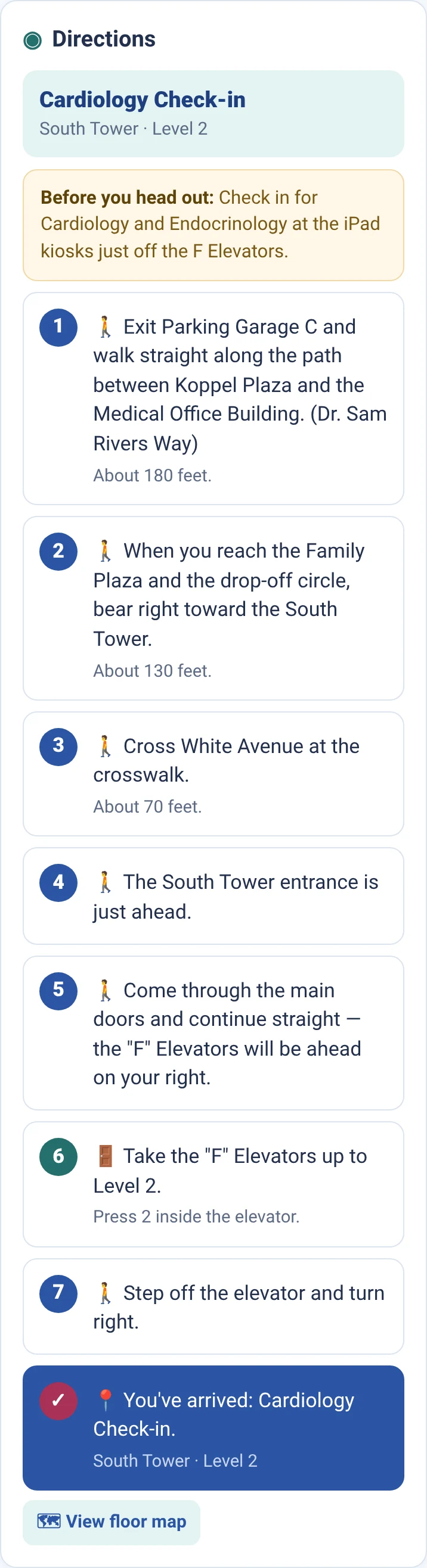
Choose where you are. Search for a department, doctor, or patient-room number. Follow directions that use familiar landmarks and clear language.
Riverview is our fictional hospital demo. Try the same working interface shown here.
Try Garage C → Cardiology (opens demo in a new tab)Explore the demo’s features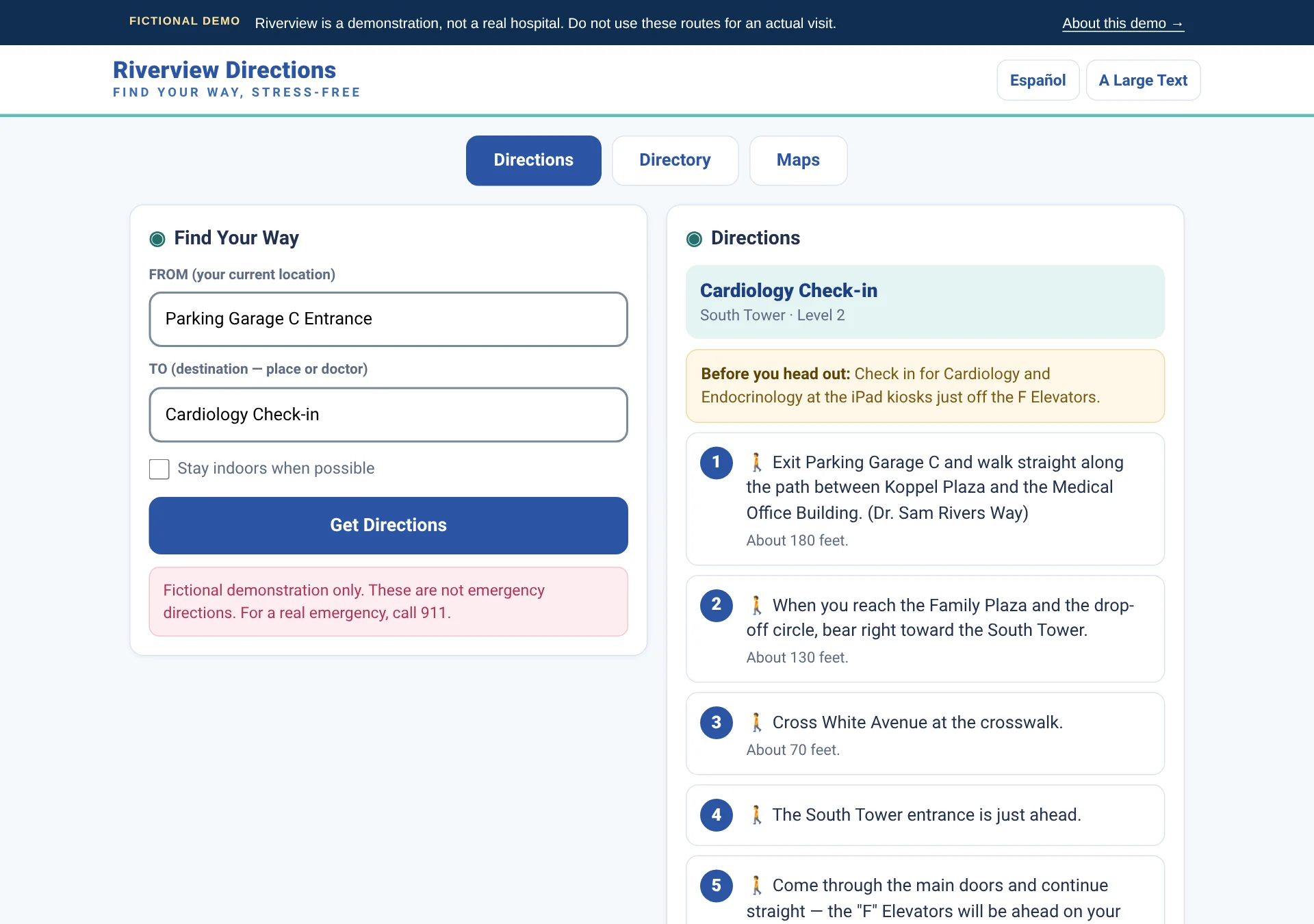

Built around the visit
Finding the right hallway shouldn’t be another thing to figure out.
Familiar landmarks and everyday names. “Blood draw” finds the lab; “brain doctor” brings up Neurology in the Riverview demo.
Switch languages inside the Riverview demo, including the route instructions.
A dedicated large-text option helps visitors follow the next instruction.
More than getting there
Sometimes the first stop isn’t the department. It’s registration.
Hospital Directions can include where to check in and what needs to happen before a visitor heads to the next location.
In Riverview’s fictional lab example, the app asks about a wristband. Visitors without one are directed to the Information Desk to begin registration before going to the lab.
Your hospital defines the check-in locations and instructions. This guides visitors to check-in; it does not register them or issue a wristband.
Try the lab check-in example (opens demo in a new tab)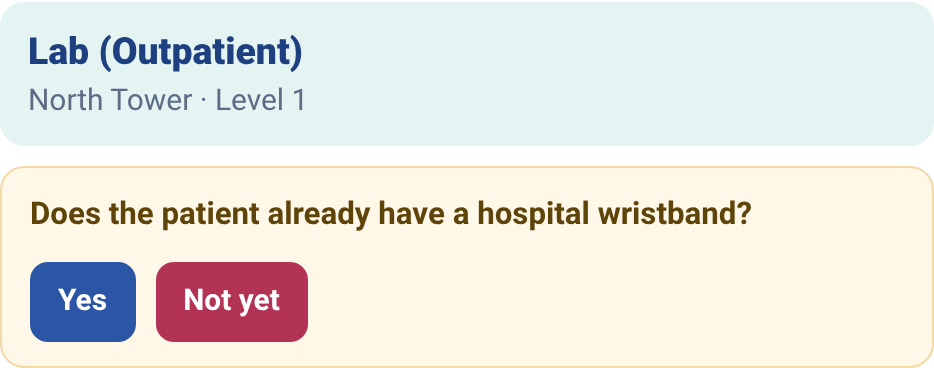
Where physical meets digital
The sign establishes the starting point.
A location-specific QR code tells Hospital Directions where the visitor is starting. They choose a destination and follow the directions in their browser.
No live location tracking is implied: the known starting point comes from the sign or the visitor’s selection.
Try this starting point (opens demo in a new tab)A clear location.
A helpful next step.

A focused approach
Hospital Directions focuses on curated routes and known starting points—not a larger indoor-location hardware rollout.
Open a QR code or link in a standard web browser.
No login stands between the visitor and the directions.
Known locations and curated paths power the core experience.
Directions use a starting point and destination, not a patient chart.
From your campus to their phone
Review entrances, destinations, check-in locations, and the everyday words visitors use to ask for directions.
Turn that knowledge into clear routes and check-in notes, then review and walk them with your team.
Introduce QR signs and direct links. Keep destinations and instructions current as your campus changes.
Founded by a hospital volunteer
While volunteering at a children’s hospital in East Tennessee, Matthew Parsons recognized how much friction finding the right place could add to a visit. He founded Hospital Directions to make that next step clearer.
Read our storyEvery implementation includes an on-site mapping visit to walk routes, verify visitor landmarks, and identify useful QR starting points in the real environment.
See how implementation works →
A clearer way forward
Tell us about your campus and the visitor journey. We’ll show you how Hospital Directions could help.
Schedule a demo today Reach out to learn more. No patient information needed.